For mid-market B2B SaaS, AI is the biggest pressure and the biggest lever of the decade.

The pressure comes from three sides at once. The competitors getting cheaper and faster around you. The board, with expectations on AI rising every quarter. And the next buyer, whose diligence team already knows exactly what they will be looking for.

// Competitive

AI-native attackers are getting cheaper, faster, and good enough.

Customer base erodes segment by segment, often before retention numbers move.

// Board

Board expectations on AI are rising every quarter.

You either set the narrative or spend the next year on defense.

// Next buyer

The next buyer's diligence team knows what to look for.

Tools and copilots are assumed baseline. Value comes from the data, workflow, and feedback loops you build into product and engineering during the hold.

AI is making the squeeze tighter.

// THE MARKET MATH

74% of AI's economic gains are being captured by the top 20% of companies.

Three quarters of the value going to one fifth of the companies. The rest are splitting the scraps. The top 20% are 2.6x more likely to be reinventing how their business works, not just squeezing efficiency.

Source: PwC 2026 AI Performance Study (n=1,217 senior executives).

This is a strategic business decision, not a technology decision.

AI reshapes cost structure, competitive position, and the kind of company you become. The first move can be focused on one part of the business. The decision behind it cannot be. It demands real prioritization, real capital, and tough trade-offs about what stops so this can move. None of those calls delegate.

Your CTO is reading, experimenting, talking about it. But the document you need for the next investor update does not exist. The strategy you can defend when a board member leans in and says "where are we on AI" is not there.

This is not a CTO problem. This is a CEO problem. And the longer you treat it as something your CTO will eventually deliver, the further behind your position drifts.

Here is the good news. You do not have to make a big bet on AI to get this right. The CEOs pulling ahead are making a sequence of small, reversible moves that compound. Each move small enough to defend, layered enough to keep building, unwound if the conditions change. Methodical beats bold in 2026.

Your CTO was not hired for this.

They were hired to run delivery, hire well, keep the lights on, and ship what the business needs every quarter. Strategic AI leadership across product and engineering is a different job with a different shape. It is sitting on top of everything they were already accountable for, and it is not what they were brought in to do.

They do have a playbook. They have run it for every technology shift of the last decade: cloud migration, microservices, mobile, database modernization. Each one started with the same three steps:

AI breaks all three.

Your CTO is operating without their normal tools. That is not incompetence. It is a structural condition that punishes exactly the strengths that made them a great CTO: pattern recognition from prior shifts, confident technical judgment, and the ability to commit to a plan and drive execution.

Opt out, move methodically, or defer.

Two of these are deliberate decisions you own. The third is what happens to any CEO who has not picked. Each carries a different cost, on different lines and at different times. Naming them separately is the first move.

// PATH A

Opt out.

Deliberate. You decided AI is not for your business.
Owned. The call is yours. You can defend it.
Permanent. You are not going to flip in a year.
OUTCOME
Defensible position. Deliberate stance.
If you have decided this, stop reading and use the time elsewhere.
// PATH B

Move methodically.

Deliberate. You picked the pace and the sequencing. Not the front of the curve. Not the back.
Owned. The trade-offs are yours, named and defensible.
Compounding. Each move teaches your team something the next buyer cannot copy.
OUTCOME
On baseline at exit. Learning curve compounds.
Premium upside depends on what you build into workflow during the hold. The next section names it.
// PATH C

Defer.

Unmanaged. Experiments continue. People are using AI. No one is steering.
Unowned. You have not decided what scales, what stops, or who owns the call.
Costly. Activity compounds without producing throughput. Position drifts.
OUTCOME
Activity rises. Throughput does not.
Position transfers to whoever is steering. The next sections name what deferring actually costs.

If you have decided AI is not for your business, stop reading and use the time elsewhere. If you are moving methodically or deferring, read on. The next sections name what your future buyer will measure either way.

Your next buyer's diligence team already knows what to look for in product and engineering.

Your next buyer will not ask whether you have AI in product and engineering. They will ask what kind. The checklist already exists. The tools and copilots that look advanced today read as baseline tomorrow. Value comes from the deeper layer: the data, the workflow integration, the feedback loops that compound as your team ships. None of that compresses well. The longer you wait, the harder it becomes to build the position that earns value at exit.

// Baseline. No credit at exit.

What they assume your SDLC has.

  • AI code completion and copilots across product and engineering
  • AI-assisted test generation and PR review
  • AI requirements summarization and doc generation
  • AI debugging and incident triage
  • Basic AI-assisted analytics on velocity and reliability
// Premium. What earns value.

What they pay extra for.

  • Proprietary engineering data. Multi-year codebase, telemetry, team velocity, and customer usage data competitors cannot source.
  • Workflow lock-in. A product and engineering operating motion so AI-integrated that swapping tooling means redesigning the SDLC, not changing a vendor.
  • Feedback loops that compound. AI getting better as your team ships, using patterns your codebase and customers uniquely generate.
  • Org-level AI fluency. Product managers and engineers using AI in daily decisions. Not a center of excellence with twelve data scientists.

Funding the baseline list does not produce the premium list. The first is operating discipline. The second has to be deliberately built, with explicit budget and explicit room on the roadmap. The CEOs pulling ahead started that work last quarter, not next.

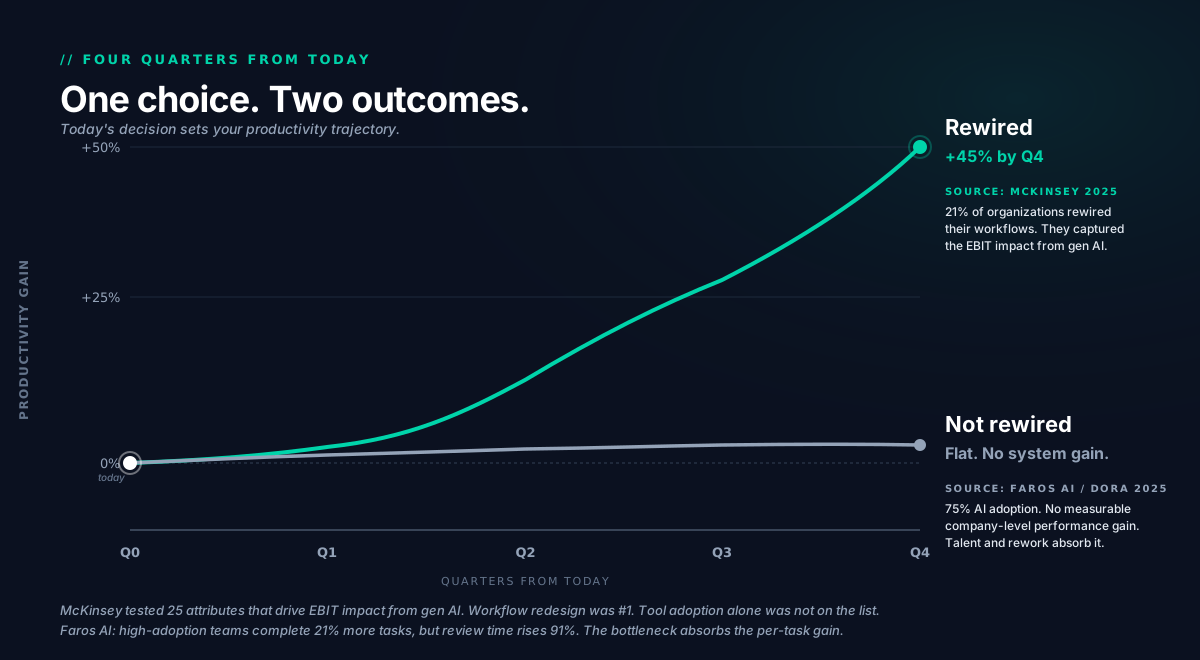
One choice. Two outcomes.

The companies that rewire their workflows capture the gain. The ones that bolt AI onto the existing system do not.

Two trajectories chart: rewired companies (McKinsey 2025, +45% productivity by Q4) versus not-rewired companies (Faros AI / DORA 2025, flat company-level gain) over four quarters

Illustrative shape. Sources: McKinsey 2025 (rewired) and Faros AI / DORA 2025 (not rewired). The AI Trajectory Read shows your actual position and where you are heading.

Want to see where you actually stand right now? The AI Litmus Test takes about five minutes.

The same conditions, run the other way, are the largest margin and growth lever in a decade.

Cost side.
  • Cheaper to build. Faster to ship. Higher quality without expanding the team.
  • Gains flow to gross margin. Margin flows to valuation. CEOs who run this right are repricing the company.
Capacity side.
  • Same product and engineering investment, more product. Bets that were too expensive become affordable.
  • The CEO now has a mix to decide between margin and new growth surface.

Four quarters from now, the companies that moved will not look like the companies that waited.

Five moves CEOs reach for that make the situation worse.

When the AI plan is not materializing, CEOs reach for moves that feel decisive. Most of them make the situation worse. The fifth is the most common: doing nothing and assuming the CTO will figure it out.

1. Hire a Chief AI Officer

Splits accountability in two. Authority to recommend, not execute. Your strongest tech leader gets defensive. The new hire gets frustrated. Average tenure: 2–3 years.

2. Mandate AI tool adoption with usage targets

Funds baseline. Does not produce the moat. Adoption goes up. Token spend goes up. Tool adoption is operating discipline. The moat (data, workflow, feedback loops) is strategic capital allocation, and the first does not produce the second.

3. Forward podcast episodes with "just do this"

Corrodes CTO trust. The story you heard is not the story that happened. Copying the outcome without the context produces cargo cult AI.

4. Bring in McKinsey or BCG

Buys a deck, not progress. Hundreds of thousands for a 100-page strategy. The deck is not what you are missing. Execution clarity owned by your CTO is.

5. Trust your CTO to just deliver this on their own

The default move. The most common failure. Your CTO is the right partner, but the original job did not shrink. Carrying AI alone, on top of delivery and hiring and the roadmap, is a CEO failure mode. The fix is structural. The call is yours.

Three things the CEOs leading through this moment are doing.

1. They own AI as a strategic bet, not delegate it as a CTO side project.

Explicit budget, explicit trade-offs, explicit accountability sitting with the CEO. The CTO is the executor of an owned strategy, not the answerer of an open question.

2. They pick two or three measurable AI moves and reorder priorities so those moves have room to land.

The ship still has to ship. The CTO still has to run delivery, hire, and keep reliability. The CEO's job is not to halt the current roadmap. It is to make explicit room for AI moves inside the existing operating cadence, and name what gets sequenced behind them, so the AI work does not compete with delivery for the same oxygen.

3. They take the reins on the board narrative instead of waiting for the next ask.

The board has already asked, or will ask next quarter. The right answer is not a fixed plan defending a single big bet. It is a measured frame: safe, layered moves that build capacity without committing the company to anything they would have to walk back six months from now.

The uncertainty is the insight. The CEOs leading through this name three things at the board table:

That frame holds up because it does not require certainty the room does not have either.

A $21M B2B SaaS CTO we worked with went from carrying the AI question alone to a board-approved plan his leadership team could execute. Read the case study for the full sequence.
Operators who speak your CTO's language.

Your CTO has context no outside firm can replace. The codebase, the team dynamics, the customer commitments. The fix is not to replace them. It is to put someone next to them who has sat in their seat before.

Operators, not consultants.

We have run product, engineering, and design organizations through agile, DevOps, product ops, and earlier AI rollouts. We work hand-in-hand with your CTO, not around them. Your CTO sets context we cannot. We bring the outside read.

Coach plus accountability.

We set up the system, name the moves, and stay in the room while your team executes. Your team owns the capability when we leave. No consultant dependency.

Your CTO is the partner, not the problem.

We do not consult on personnel decisions. We give you the structure and the outside read so your CTO can lead this work effectively. The CEO decides what to do with the read.

Three lightweight next steps. Pick the one that fits your situation.

// Step 1. 5 minutes

Take the AI Litmus Test

Eight questions on whether AI is compounding in product and engineering or stuck as activity. Score each answer. The score tells you where you stand. The unanswered questions become the agenda. Free, no email gate up front.

Take the AI Litmus Test
// Step 2. One week

Book the AI Trajectory Read

Working time with you and your product and engineering leaders, hands-on with your team. A five-page read and live presentation delivered within one week. The smallest paid step before AI Catalyst.

See the AI Trajectory Read
// Step 3. AI Catalyst

The deeper engagement

The deeper engagement, once the Read has clarified the moves worth funding and executing. We work two-in-a-box with your single-threaded internal lead on the first wave of moves, until the operating system is in place to run without us.

Request a Fit Call