Most AI governance conversations start with policy. Approval workflows. Usage guidelines. Compliance checklists. Six months later, nothing has shipped, but you have a beautiful 40-page document nobody reads.
The problem is not that governance is wrong. It is that governance designed to prevent mistakes also prevents learning. And most organizations right now need to learn faster, not slower.
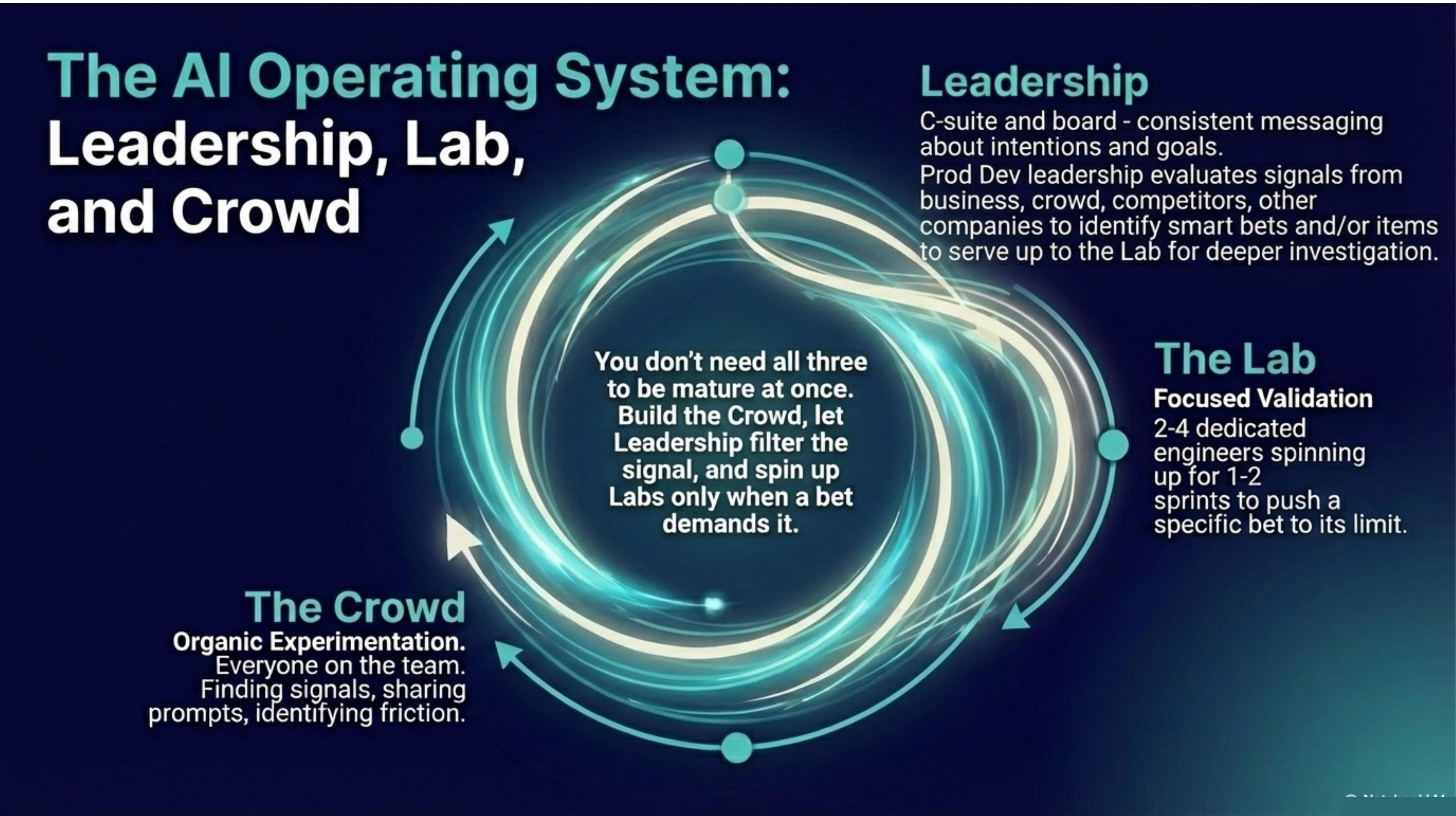
This is the operating structure we use with teams that are past scattered experimentation but have not figured out how to make AI compound. It requires three groups with clear roles. No committee. No governance board. No quarterly review cycle that everyone dreads.
Why the Lab matters more than policies
Here is the pattern I see in almost every mid-market org trying to make AI work.
Leadership says AI is a priority. People start experimenting. A few individuals get good at using AI tools in their own workflow. Their personal productivity goes up. But nothing spreads. Nothing compounds. The knowledge stays locked in the person who figured it out, and when they leave or get pulled onto something else, the capability walks out with them.
"Policies do not fix this. What fixes it is deliberately building expertise in specific people, giving them time and cover to go deep, and then making their job to spread what works."
Without a deliberate structure, you get two failure modes. Either AI stays a collection of personal hacks that never become organizational capability. Or leadership mandates adoption and teams comply performatively, usage numbers go up, and actual value stays flat.
The three groups
Group 1
Leadership
CEO, CTO, CPO, and the senior leaders who own the business outcome. Their job is not to pick tools or evaluate experiments. Their job is to answer three questions: What business outcomes matter enough to bet AI time on this quarter? How much protected capacity are we willing to commit? What does "good enough to keep going" look like at 30 days?
If leadership cannot answer those three questions, everything downstream is guessing. And the most common failure here is familiar: leadership says "AI is a priority" but does not commit capacity. That is not a priority. That is a wish.
Group 2
The Lab
Two to five of your strongest operators with a temporary additional mandate: build deep AI expertise in a specific area and make it transferable. These are your champions. Not your most enthusiastic AI people. Your best operators who already have credibility with the team.
Each champion owns one or two AI hypotheses tied to a specific business outcome. They run experiments with 30-day checkpoints. And critically, they teach what they learn. A champion who builds expertise but does not transfer it is just a power user.
Group 3
The Crowd
Most of your organization lives here. The guardrails are simple: use AI tools if they help you. Do not put customer data into tools that are not approved. If you find something that saves you real time, share it. Nobody is required to use AI. Nobody is prevented from using it.
The Crowd is where organic adoption patterns emerge. Champions in the Lab watch for those patterns. Someone in QA figured out a way to use AI for test case generation? A PM is drafting PRDs faster? The champion's job is to notice, evaluate whether it is worth scaling, and connect it to the hypotheses leadership approved.
Why this structure works
The three groups solve three distinct problems that governance policies alone cannot touch.
Leadership provides direction and air cover. Without leadership answering the three questions, the Lab is guessing at priorities and the Crowd has no guardrails. Without leadership protecting capacity, nobody takes the Lab role seriously because they know they will get pulled back to "real work" the moment something urgent comes up.
The Lab is the bridge between individual experimentation and organizational capability. It is the change management layer most AI governance models skip entirely. Champions build deep expertise, but their job is not just to be good at AI. Their job is to make the expertise portable. Monthly demos, pattern-spotting, and connecting organic adoption to strategic bets. This is how knowledge stops walking out the door when individuals leave.
The Crowd keeps adoption voluntary and honest. Nobody is forced to use AI. Nobody is performing compliance for a dashboard. The signal that something works comes from the people doing the work, not from a mandate. That signal feeds back to the Lab, which feeds it to Leadership, which adjusts priorities. The loop closes.
What this prevents
AI chaos.
Everyone experiments, nothing compounds, and six months later the CEO asks "what did we get from AI?" and nobody has a defensible answer. The Lab prevents this by concentrating the highest-impact work and connecting it to outcomes leadership defined.
AI theater.
Leadership mandates adoption. Teams comply performatively. Usage dashboards look great. Value stays flat. The Lab prevents this by making adoption useful rather than mandatory. If a champion cannot show you a real workflow that saves real time, nobody is forced to pretend otherwise.
Knowledge walkout.
Your best AI user leaves and their capability leaves with them. The Lab prevents this because transfer is built into the role. The organization learns, not just the individual.
When this evolves
This model is a bridge, not a destination. It is for organizations past scattered experimentation but before AI is embedded in how they operate.
Signs you are ready to evolve: the Lab's bets are consistently succeeding and the Crowd is adopting their work naturally. Leadership's three questions are easy to answer because AI is part of how they think about the business. You have enough data on what works that AI can move into your normal planning and budgeting cycles instead of running as a separate effort.
When that happens, the Lab dissolves into normal team leadership and AI governance becomes standard operating procedure. But that takes 6 to 12 months of this operating rhythm first.
How you set up the three groups, design the communication cadence between them, select the right champions, and protect their capacity while keeping leadership engaged is where the details matter. The model is simple. Making it work inside a real organization that is already stretched is not.
If your AI governance is either nonexistent or producing documents nobody reads, we should talk.
AI Catalyst helps product and engineering leaders stand up this operating structure, select and prepare champions, and build the leadership alignment to sustain it. In weeks, not quarters.
Request a Fit Call
// Written by

Martin Wilson
Co-Founder, OLO Solutions
Martin has spent 20 years building and scaling product development teams and leading organizations through major transitions. He works with CEOs and product and engineering leaders who are stuck between scattered AI activity and coherent execution.
LinkedIn →
Scott Varho
Co-Founder, OLO Solutions
Scott has led product, engineering, and design organizations through technology shifts at multiple scales. He works with CEOs and CTOs on the structural calls behind AI in product and engineering.
LinkedIn →