Most AI investment decisions inside product and engineering teams follow the same pattern. Someone gets excited about a tool. A pilot starts. Six weeks later, the pilot is either abandoned or running on momentum with no clear connection to a business outcome. Leadership asks what they got for the time spent. Nobody has a good answer.
The problem is not that teams lack ideas. Most teams have too many. The problem is that there is no structured way to decide which ideas deserve real capacity and which ones are interesting distractions.
This is the evaluation framework we use with teams to turn scattered AI activity into a short list of bets the business can actually support. It is not complicated. But it forces the kind of clarity that most AI conversations skip entirely.
One thing worth saying up front: the first smart bets are not chosen only for ROI. They are chosen for what they unlock organizationally. The right first bet gives leadership evidence, gives the team confidence, and gives the organization permission to keep funding the next two bets. A bet that works in isolation but does not create credibility is weaker than it looks.
Start with a hypothesis, not a tool
The single biggest mistake teams make with AI investment is leading with the tool. "We should use Claude for code review." "Let's try Copilot for the engineering team." "Can we use AI to automate QA?"
These are tool decisions masquerading as strategy. They skip the step that matters: connecting the AI work to a business outcome someone actually cares about.
Before you pick a tool, write a hypothesis. One sentence. This format:
Hypothesis Format
"We believe applying AI to [specific area of friction] will impact [measurable business outcome] by [estimated magnitude], which matters because [business reason]."
Here is what a real one looks like:
Example
"We believe applying AI to customer interview synthesis will reduce the time from research to feature spec by 40%, which matters because our current 6-week discovery cycle is the bottleneck holding back our release cadence."
Notice what this does. It names the friction. It names the outcome. It gives a number, even if the number is approximate. And it connects to a business reason that leadership already cares about.
To see the gap clearly, contrast a weak hypothesis with a stronger one:
Weak
"We should use AI for code review."
Better
"We believe applying AI to first-pass pull request review will reduce review cycle time by 25%, which matters because review latency is the bottleneck slowing release readiness."
The first version names a tool use case. The second names friction, outcome, and business relevance.
If you cannot fill in all four blanks, the idea is not ready for investment. It might be interesting. It might even be useful. But it is not a bet you can defend to your CEO, and you should not be spending protected capacity on it.
Why hypotheses beat roadmaps here
Traditional technology investments get roadmaps. Define the current state. Define the target state. Draw the path between them. That works when the landscape holds still long enough to execute.
AI does not hold still. The models change capability every few weeks. What was impossible in January is table stakes by April. What worked last quarter might be obsolete. The normal planning cadence of define, scope, build, measure breaks when the terrain shifts faster than your planning cycle.
"You are not committing to a destination. You are committing to a 30-day experiment with a clear success criterion."
Hypotheses work better because they are designed to be tested and revised. If the experiment works, you invest more. If it does not, you learned something and you move to the next bet. Partial results are still data. That is a fundamentally different relationship with uncertainty than a roadmap gives you.
This is not permission to be vague. The hypothesis format forces specificity. But the specificity is in the problem and the outcome, not in the solution path. You leave the solution path open because you do not know yet what will work.
The Smart Bet Evaluation Framework
Once you have a hypothesis, you need to decide if it is worth the capacity. Not every good idea deserves a slot. You have limited time, limited political capital, and a team that is already stretched.
If you cannot explain why a bet matters in board language, it is not a smart bet yet. That does not mean every bet needs to be presented to the board. It means every bet should be translatable into a business outcome the CEO can defend when asked why this work deserves protected capacity.
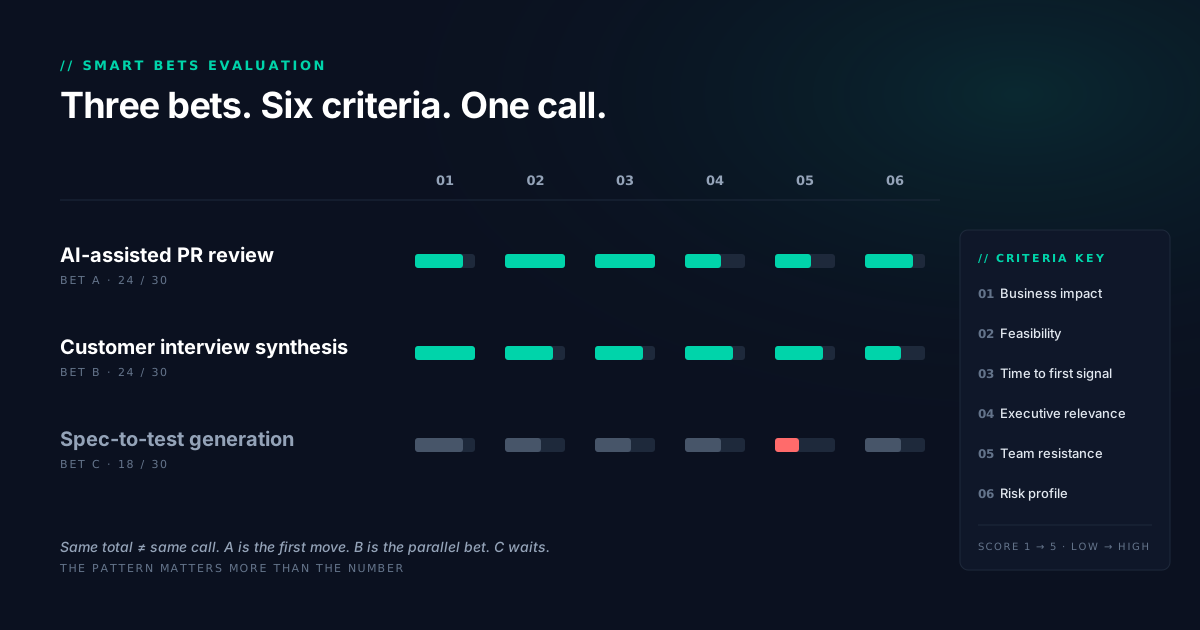
Score your hypothesis on six criteria. Each one gets a 1 to 5. The scoring is directional, not precise. You are looking for separation between bets, not decimal accuracy.
01
Business Impact
Is there a clear line between this bet and a metric the board actually tracks? Revenue, margin, retention, velocity, cost per unit. If the connection requires a paragraph to explain, the score drops.
02
Feasibility
Can your current team execute this in the next 30 to 90 days with the data, access, skills, and tooling you already have? A bet that requires two new hires and a vendor contract is a project, not an experiment.
03
Time to First Signal
How quickly will you know if this is working? The best bets produce evidence in two to four weeks. Not proof. Evidence. Enough data to decide whether to keep going.
04
Executive Relevance
Will this bet build credibility with the CEO, board, or executive team and create air cover for the next wave of AI work? Early bets are not only judged on value. They are judged on whether they earn permission to keep going.
05
Team Resistance
Will the people doing the work lean in or push back? Your first bets should not depend on overcoming resistance. Start with your most willing operators. You can tackle the resistant pockets later.
06
Risk Profile
What happens if this fails? A bet on internal tooling that does not work out is low risk. A bet on customer-facing AI that produces bad output is high risk. Factor the downside, not just the upside.
Reading the scores
Add up the six scores. The total gives you a rough ranking. But do not just pick the highest number mechanically. Look at the pattern.
High business impact + high leadership excitement, but low feasibility.
A great idea with a timing problem. Park it. Come back in 90 days when the conditions change.
High feasibility + fast signal, but low business impact.
A quick win that will not build credibility. Fine as a learning exercise, but do not present it to your CEO as evidence that AI is working.
High business impact + high feasibility + fast signal.
This is the combination you want. You can start fast, learn fast, and connect the results to something leadership cares about. These are your first bets.
The disagreements matter more than the scores. If one person scores team resistance at a 2 and another scores it at a 4, that gap tells you something real about how the team feels about the work. Those conversations are where the framework earns its keep.
A smart bet is not just a high-scoring bet. It is a bet the organization can absorb, defend, and learn from quickly.
What this prevents
Scattered experimentation.
Instead of fifteen people trying fifteen different things, you have one or two focused bets tied to outcomes leadership defined. The rest of the team can still experiment individually, but the organization's capacity is concentrated where it matters.
Zombie projects.
Every bet has a 30-day checkpoint and kill criteria defined before it starts. If the signal is not there, you stop. You do not keep going because someone is emotionally invested or because stopping feels like failure.
Political disconnection.
Because the hypothesis is framed in business language and leadership excitement is one of the scoring criteria, the work stays connected to what the executive team cares about. You are not building something brilliant that nobody asked for.
Tool fixation.
The framework deliberately separates the problem from the solution. You decide what friction to attack and what outcome to measure before you decide which tool to use. This prevents the pattern where someone falls in love with a tool and then goes looking for a problem to justify it.
The operating rhythm
This is not a one-time exercise. Run the framework at the start of every 30-day cycle. As bets complete or get killed, new hypotheses enter the evaluation. The scores shift because conditions change. Team resistance drops after a successful first bet. Leadership excitement increases when they see real results. Feasibility improves as the team builds skill.
The framework is the operating rhythm that keeps your AI investments disciplined and connected to the business. Without it, you are back to scattered experimentation within 90 days.
A framework is not the hard part. The hard part is forcing trade-offs, protecting capacity, and keeping the work tied to outcomes once the organization starts pulling it back toward scattered activity. That is where most teams fail.
If your AI activity is scattered and nothing is compounding, we should talk.
If your AI activity is scattered and your leadership team cannot yet defend which bets matter, AI Catalyst helps turn this framework into real operating discipline: clearer hypotheses, sharper prioritization, protected capacity, and leadership alignment that survives pressure.
Request a Fit Call
// Written by

Martin Wilson
Co-Founder, OLO Solutions
Martin has spent 20 years building and scaling product development teams and leading organizations through major transitions. He works with CEOs and product and engineering leaders who are stuck between scattered AI activity and coherent execution.
LinkedIn →

Scott Varho
Co-Founder, OLO Solutions
Scott has led product, engineering, and design organizations through technology shifts at multiple scales. He works with CEOs and CTOs on the structural calls behind AI in product and engineering.
LinkedIn →