// Essay
Why Your CTO Hasn't Built the AI Plan You're Waiting For
It is not a competence problem. It is a structural condition. Here is what's actually happening, what backfires, and what helps.

It is not a competence problem. It is a structural condition. Here is what's actually happening, what backfires, and what helps.
You're waiting for an AI plan from your CTO that hasn't shown up.
The board is asking. The competition is moving. Your CTO is reading, experimenting, talking about it. But the document you need to share with the board, the strategy you can stand behind in the next investor update, the answer to "how are we going to win on AI," isn't there yet.
You're not alone. We work with mid-market SaaS CEOs and CTOs across this exact moment, and the pattern is consistent enough that we want to share what's actually happening, what's helping, and what backfires.
This article is about your product delivery organization specifically. Not enterprise-wide AI, not how marketing or sales adopt AI, not data governance. The narrow question: why is the AI transformation of how your company builds, ships, monitors, and maintains its product moving slower than you expected?
Your CTO is smart. The team is competent. They've shipped through everything you've thrown at them for years.
And yet AI in your product delivery isn't moving the way it needs to.
This is happening across the mid-market. It is not a story about your CTO being uniquely behind. It is a story about a structural condition affecting almost every CTO in your peer set, and the leaders who navigate it well do so by understanding the conditions, not by trying harder.
Your CTO has a playbook for technology transformations. AS-IS, TO-BE, and a credible path between. Define the starting state. Define the destination. Sequence the steps. They've used this playbook for cloud migration, microservices, mobile, every major technology bet of the last decade. It's worked.
AI breaks all three. The AS-IS is moving: your team's tooling shifts monthly and model capabilities change quarterly. The TO-BE has no consensus: nobody agrees what good looks like, even the benchmarks are figuring it out in real time, last quarter's authoritative voices have already revised their positions. The path is invisible: even if the start and end were stable, the credible sequence of steps doesn't exist yet. The technology is moving faster than (good) playbooks can be written.
Your CTO is operating without their normal tools. That's not a competence problem, it's a conditions problem. And it punishes exactly the strengths that made them a great CTO: pattern recognition, confident technical judgment, the discipline to commit and drive execution.
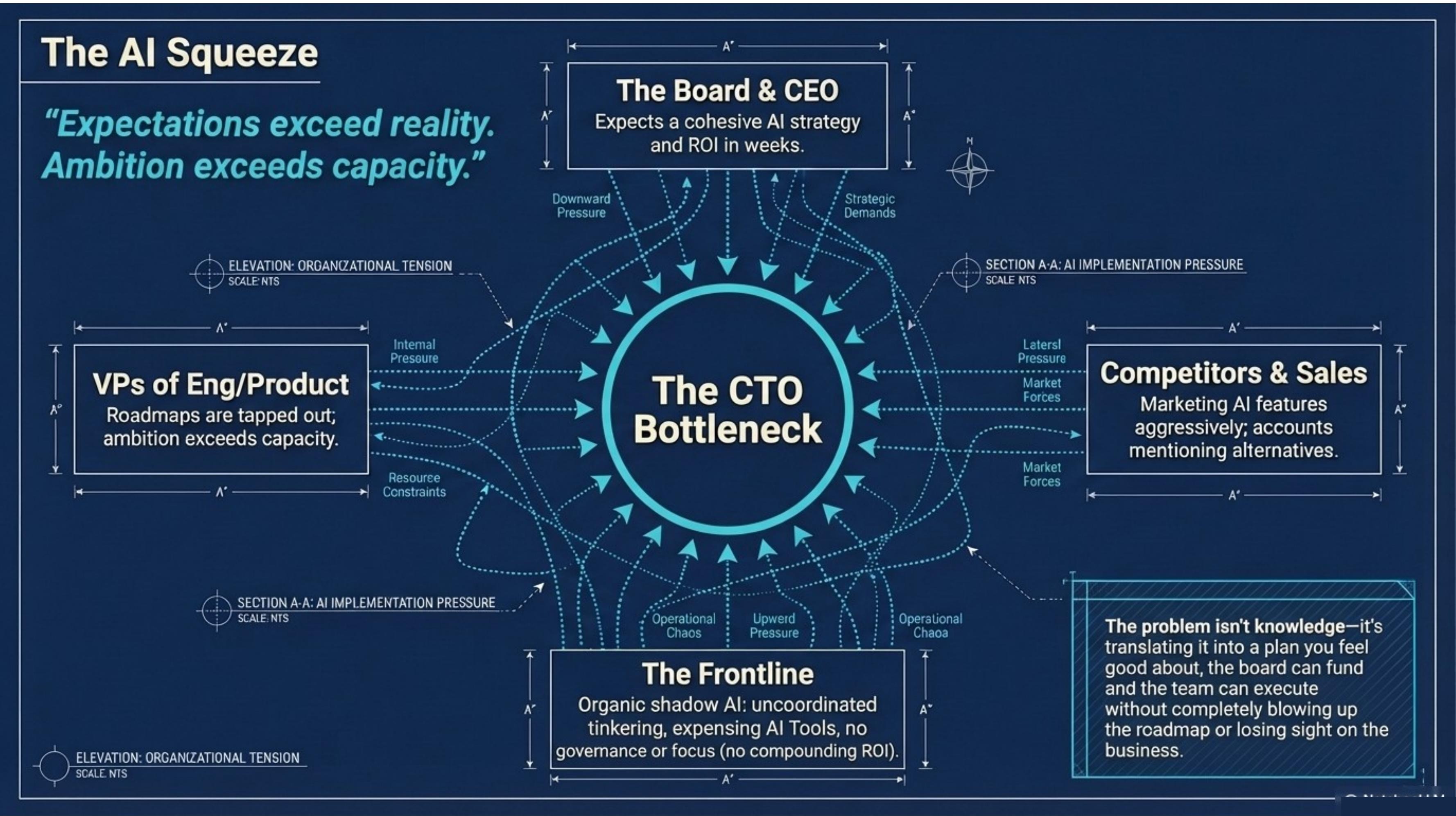
We call this the Delivery Squeeze. A CTO compressed between a board that wants AI yesterday, a team that can only absorb so much change, a technology landscape that won't sit still, and their own instinct to wait for clarity. Any one of those is manageable. Four at once is a different problem.
The CTOs landing AI strategy well right now have figured out something specific: they've stopped trying to apply the old playbook and started building a different one designed for these conditions. The ones still struggling are still waiting for the conditions to stabilize so the old playbook can work again.
It's not going to stabilize. Not in time.
When the AI plan isn't materializing, CEOs reach for moves that feel decisive. Most make the situation worse. Five we see often:
The CEOs and CTOs who navigate this well stop waiting for conditions to stabilize and build a different operating model designed for instability. It starts with diagnosing where the actual gap is. Strategy. Execution. Capability. Alignment. Four answers, four different responses, and getting the diagnosis wrong is how CEOs end up making the backfiring moves above.
Your CTO is the right owner of this work. They need different conditions, not different leadership. AI capability is becoming a real competitive advantage in B2B SaaS, which means it deserves real leadership investment, not a delegation. The CEOs who get this right invest in helping their CTO build the new playbook.
A few hours with you and your product and engineering leaders. A five-page document and presentation delivered within a week. Money-back guaranteed if it does not surface three specific AI moves you can defend to your board.
See the AI Trajectory Audit